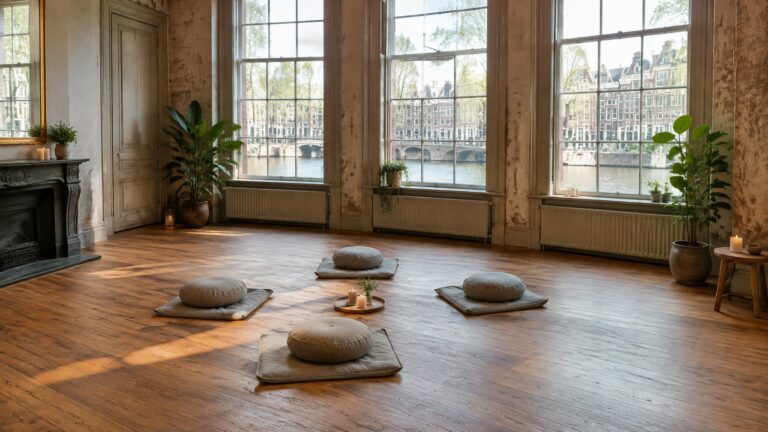
There is a particular kind of noise in a busy city.
It is not only the bells of bicycles and the hum of trams.
It is the inner chatter that rises when every minute is filled.
Amsterdam is a beautiful city, but like any capital it can pull your attention in a hundred directions at once.
Stillness is not something you have to travel far to find. Often it is waiting in a quiet room a few streets away, on a mat, in a breath you finally allow yourself to take slowly.
Key Takeaways
- Stillness is a practice, not a place, but the right space makes it easier to begin
- Different yoga styles open different doors: movement, breath, meditation or play
- A short daily ritual at home keeps the calm alive between classes
- Choose a teacher and a community that feel welcoming to your whole self
Why Stillness Matters More in the City
Spiritual traditions across the world agree on one thing: the soul needs pauses.
In a crowded city, those pauses rarely happen by accident.
We move from screen to street to screen, and the quiet voice inside, the one many people describe as intuition or spirit, struggles to be heard.
Yoga offers a way back.
Whether it is a slow flow, a long hold in a restorative pose or a few minutes of seated meditation, the practice gives the nervous system a signal that it is safe to soften.
Many people describe that softening as the moment they feel connected again, to themselves and to something larger.
Finding a Practice That Speaks to You
Not every style suits every person.
Some seekers need movement before they can be still.
Others are drawn straight to the cushion.
A few want something playful that lifts them, quite literally, off the ground.
Aerial yoga is one of the more unusual paths.
It uses a soft fabric hammock suspended from the ceiling, so the body can hang, stretch and invert with support. Aerial Yoga Nederland Academy is an aerial yoga specialist in the Benelux, based in Amsterdam, and offers teacher training courses as well as equipment for anyone who wants to try this style or teach it.
For people who feel heavy or stuck, the sensation of being held by the fabric can be a gentle lesson in trust and surrender.
Meditation and the Contemplative Path
For others, stillness comes through traditions that treat yoga as part of a wider spiritual life.
Tibetan Buddhism, for example, combines meditation, movement and study as one path toward awareness and compassion.
On the Reguliersgracht, one of the city’s prettiest canals, Nyingma Centrum Nederland is a Tibetan Buddhist centre offering Tibetan yoga and meditation classes.
It also has a Buddhist temple, a gift shop and opportunities for volunteer work.
A place like this reminds visitors that stillness is not only a personal refuge.
It can also become a way of serving others.
How to Choose a Studio
When you look for a studio, notice how you feel when you walk in.
A space can be beautiful and still feel cold, or simple and feel like home.
A few questions help:
- Does the teacher explain the practice in a way that invites you in, rather than leaving you to keep up?
- Is there room for beginners, and are modifications offered without judgement?
- Does the studio honour the spiritual roots of yoga, or treat it purely as exercise, and which do you want?
- Can you reach it easily on a normal weekday, so that showing up becomes a habit?
If you want to compare options across neighbourhoods, there is a practical overview on finding a yoga studio in Amsterdam that sets out what to look for in classes and teachers.
Carrying Stillness Home
A class once a week is a gift, but the deeper change happens in the small rituals between classes.
Try one of these simple practices:
- Morning breath: before you look at your phone, take ten slow breaths with your hand on your heart.
- Canal pause: when you cross a bridge, stop for one moment and watch the water move.
Let it remind you that everything flows.
- Evening release: lie on the floor with your legs up the wall for five minutes and let the day drain away.
- Gratitude at dusk: name three moments from the day that felt like grace, however small.
These habits ask very little time, yet they create a thread of calm that runs through even the busiest week.
Frequently Asked Questions
Do I need to be flexible to start yoga?
No. Flexibility is a result of practice, not a requirement for it.
Tell the teacher you are new and they can suggest gentler versions of each pose.
Is yoga a spiritual practice or exercise?
It can be either, or both.
In its traditional form yoga is a spiritual discipline, and many studios still teach breath and meditation alongside the postures.
How often should I practise to feel calmer?
Consistency matters more than length.
A few minutes every day often does more for inner peace than one long session a week.
Amsterdam will always be lively, and that is part of its charm.
But within the rush there are quiet rooms, patient teachers and old traditions waiting to welcome you.
Step inside one, unroll the mat and let the city fall silent for a while.